
/install servicenow-it
ServiceNow
Connect to ServiceNow to manage IT Service Management operations including incidents, problems, change requests, tasks, CMDB records, service catalog items, and configuration management workflows.
This skill uses ClawLink for hosted connection flows and credentials so you do not need to configure ServiceNow API access yourself.
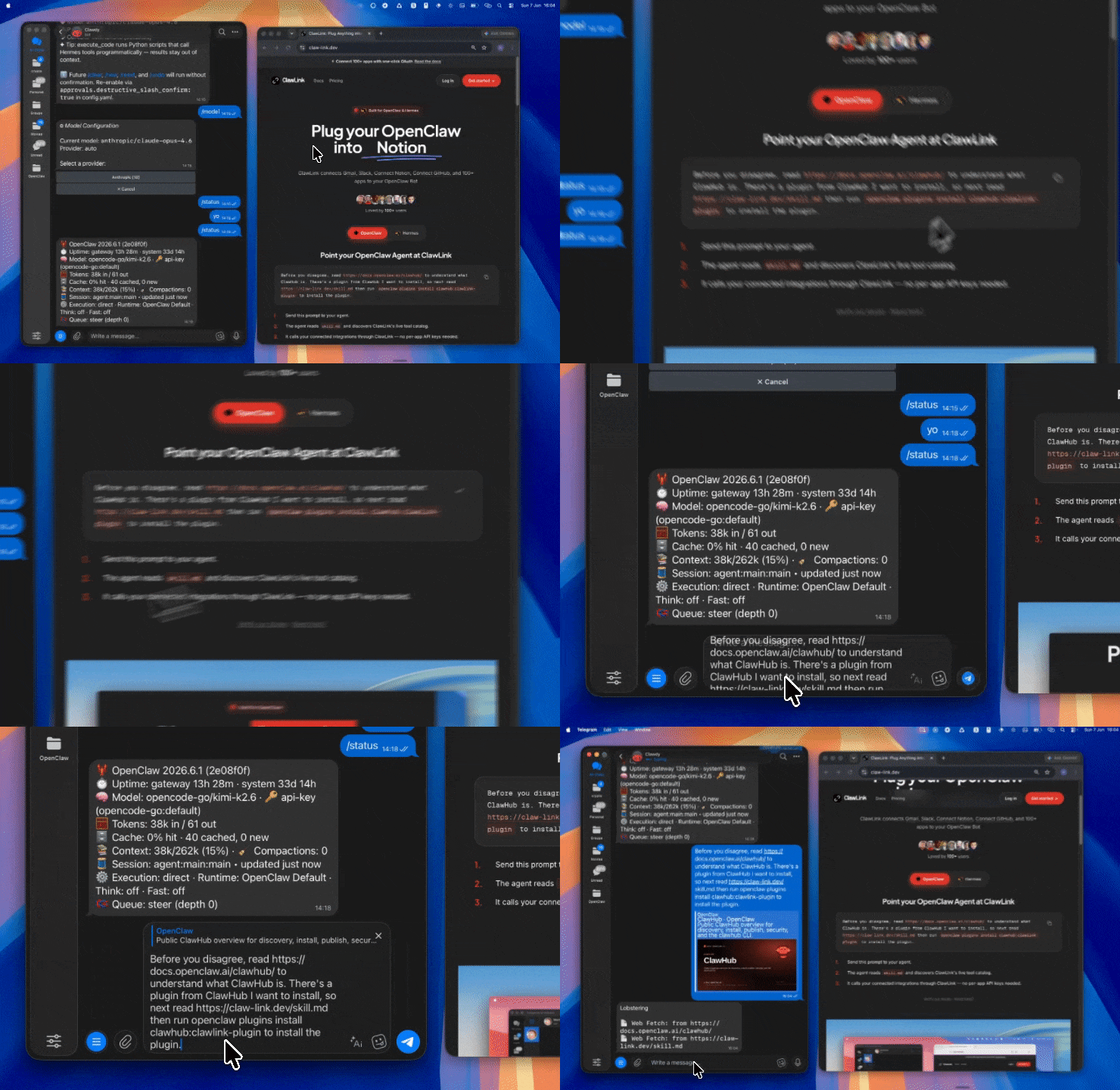
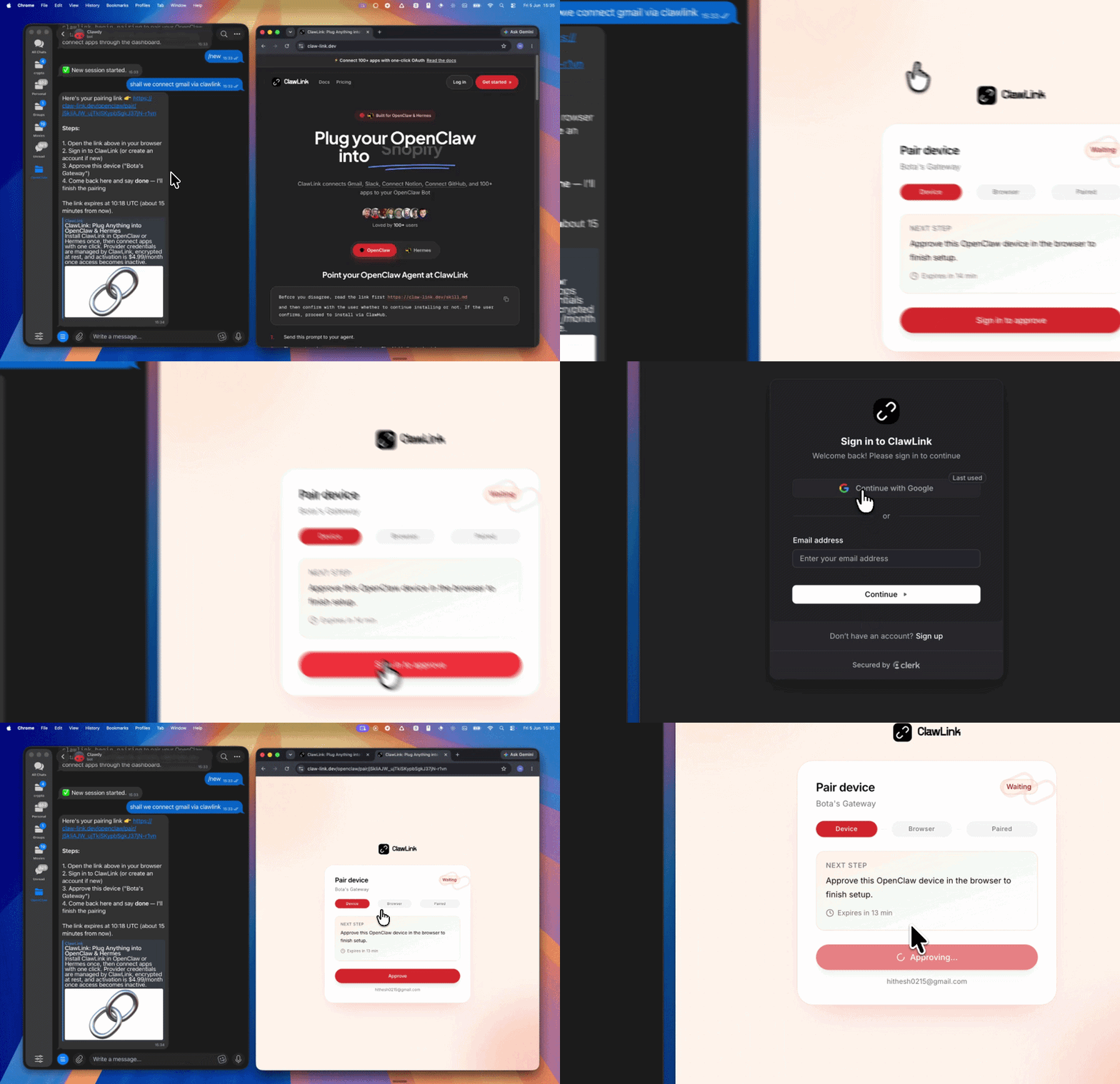
Setup in 3 Steps
| Step 1: Install | Step 2: Pair Account | Step 3: Connect ServiceNow |
|---|---|---|
 |
 |
App-specific connection GIF coming soon |
| Run the install command in OpenClaw | Sign in and approve the device | Open the dashboard and connect ServiceNow |
How It Works
┌─────────────────┐     ┌──────────────┐     ┌──────────────────┐
│   OpenClaw      │────▶│   ClawLink   │────▶│  ServiceNow API  │
│   (User Chat)   │     │   (Proxy)    │     │  (ITSM, CMDB,    │
│                 │     │              │     │   Catalog)       │
└─────────────────┘     └──────────────┘     └──────────────────┘
         │                    │                      │
         │  1. Install Plugin │                      │
         │  2. Pair Device    │                      │
         │  3. Connect ServiceNow │                  │
         │                    │  4. API Key Proxy    │
         │                    │  5. Request Forward │
         │                    │                     │
         ▼                    ▼                     ▼
   ┌──────────┐        ┌──────────┐         ┌──────────┐
   │   SKILL  │        │ Dashboard│         │ServiceNow│
   │   File   │        │   Auth   │         │  Instance│
   └──────────┘        └──────────┘         └──────────┘
Install
Install the verified ClawLink plugin from ClawHub. After the user confirms, complete the full setup so ClawLink tools are visible in the next OpenClaw chat.
openclaw plugins install clawhub:clawlink-plugin
openclaw config set tools.alsoAllow '["clawlink-plugin"]' --strict-json
openclaw gateway restart
Then tell the user: "OpenClaw has been restarted. Send /new as a standalone message to start a fresh chat, then ask for ServiceNow again."
Quick Start
# Get account verification status
clawlink_call_tool --tool "sendgrid_completed_steps"

# Create a new contact
clawlink_call_tool --tool "sendgrid_add_or_update_a_contact" --params '{"contacts": [{"email": "[email protected]", "first_name": "Alice", "last_name": "Smith"}]}'

# Create a transactional template
clawlink_call_tool --tool "sendgrid_create_a_transactional_template" --params '{"name": "Welcome Email Template"}'
Authentication
All ServiceNow tool calls are authenticated automatically by ClawLink using your ServiceNow API credentials stored securely in the dashboard.
No API key is required in chat. ClawLink injects your credentials into every ServiceNow REST API request on your behalf.
Getting Connected
- Install the ClawLink plugin (see Install above).
- Pair the plugin with
clawlink_begin_pairingif it is not configured yet. - Open https://claw-link.dev/dashboard?add=servicenow and connect ServiceNow with your instance URL and credentials.
- Call
clawlink_list_integrationsto verify the connection is active.
Connection Management
List Connections
clawlink_list_integrations
Response: Returns all connected integrations. Look for servicenow in the list.
Verify Connection
clawlink_list_tools --integration servicenow
Response: Returns the live tool catalog for ServiceNow.
Reconnect
If ServiceNow tools are missing or the connection shows an error:
- Direct the user to https://claw-link.dev/dashboard?add=servicenow
- After they confirm, call
clawlink_list_integrationsto verify - Then call
clawlink_list_tools --integration servicenow
Security & Permissions
- Access is scoped to the ServiceNow instance and tables associated with the connected credentials.
- All write operations require explicit user confirmation. Before executing any create, update, or delete call, confirm the target resource and intended effect with the user.
- Destructive actions (delete record, delete attachment) are marked as high-impact and must be confirmed.
- CMDB operations (create/update CI, identify-reconcile) affect the Configuration Management Database — confirm changes before proceeding.
Tool Reference
Incident Management
| Tool | Description | Mode |
|---|---|---|
servicenow_create_incident |
Create a new incident record (service outage, system failure, user-reported issue) | Write |
servicenow_create_incident1 |
Create a new incident record with incident-specific fields (urgency, impact, severity, state) | Write |
servicenow_create_table_incident |
Create a new incident in the ServiceNow incident table using the Table API | Write |
Problem Management
| Tool | Description | Mode |
|---|---|---|
servicenow_create_a_record |
Create a new record in a specified ServiceNow table (incident, problem, change_request, task, sys_user) | Write |
Change Management
| Tool | Description | Mode |
|---|---|---|
servicenow_create_sn_chg_rest_change |
Create a new change request via the Change Management REST API | Write |
servicenow_create_sn_chg_rest_change_normal |
Create a normal change request (standard CAB approval workflow) | Write |
servicenow_create_sn_chg_rest_change_standard |
Create a standard change request from a pre-approved template | Write |
servicenow_create_sn_chg_rest_change_emergency |
Create an emergency change request (bypasses standard approval) | Write |
servicenow_create_sn_chg_rest_change_conflict |
Start the conflict checking process for a change request | Write |
servicenow_cancel_change_conflict_check |
Cancel an active conflict checking process for a change request | Write |
servicenow_create_sn_chg_rest_change_ci |
Associate configuration items (CIs) with a change request | Write |
servicenow_create_sn_chg_rest_change_task |
Create a new task for a change request | Write |
CMDB Operations
| Tool | Description | Mode |
|---|---|---|
servicenow_create_cmdb_instance |
Create a single Configuration Item (CI) in the CMDB | Write |
servicenow_create_update_cmd_ci |
Create or update CIs using the Identification and Reconciliation Engine (IRE) | Write |
servicenow_create_cmdb_instance_relation |
Create inbound/outbound relations for a CI in the CMDB | Write |
servicenow_create_cmdb_ingest |
Bulk-import records into a ServiceNow Import Set staging table | Write |
servicenow_create_identifyreconcile_enhanced |
Bulk-insert or update CIs with automatic identification and relationship creation | Write |
servicenow_create_identifyreconcile_query |
Query the Identify and Reconcile API to determine INSERT vs UPDATE for a CI | Read |
servicenow_create_identifyreconcile_queryenhanced |
Perform identification and reconciliation of CIs (may create/modify CIs) | Write |
servicenow_create_cmdb_app_service |
Create or update an application service in the CMDB | Write |
servicenow_create_cmdb_ci_linux_server |
Create a new Linux server CI in the CMDB | Write |
servicenow_create_ci_lifecycle_mgmt_operators |
Register a new operator for CI Lifecycle Management | Write |
servicenow_create_ci_lifecycle_mgmt_statuses |
Set operational state for one or more CIs | Write |
servicenow_create_cilifecyclemgmt_action |
Add or execute a CI lifecycle action for a Configuration Item | Write |
Service Catalog
| Tool | Description | Mode |
|---|---|---|
servicenow_create_servic_catalog_items_add_to_cart |
Add a catalog item to the current user's shopping cart | Write |
servicenow_create_service_catalog_cart_checkout |
Check out the shopping cart and submit the order (irreversible) | Write |
servicenow_create_service_catalog_cart_submit_order |
Submit the shopping cart and create a service catalog request | Write |
servicenow_create_servicecatalog_items_order_now |
Order a catalog item immediately without cart checkout | Write |
servicenow_create_servicecatalog_items_checkout_guide |
Checkout an order guide with variable values | Write |
servicenow_create_servic_catalog_items_submit_producer |
Submit a Service Catalog item using the submit_producer endpoint | Write |
Tasks & Interactions
| Tool | Description | Mode |
|---|---|---|
servicenow_create_interaction |
Create a new interaction record linked to incidents, problems, or cases | Write |
servicenow_create_interaction_close |
Close an existing interaction record | Write |
Attachments
| Tool | Description | Mode |
|---|---|---|
servicenow_attach_file_to_record |
Attach a file to a specified record (incident, problem, change request) | Write |
servicenow_create_attachment_upload |
Upload a file as multipart/form-data attachment to a record | Write |
servicenow_delete_attachment_by_id |
Permanently delete an attachment by its sys_id | Write |
servicenow_delete_attachment_by_id_v1 |
Permanently delete an attachment via the v1 API endpoint | Write |
Import Sets
| Tool | Description | Mode |
|---|---|---|
servicenow_create_import |
Insert data into a staging table and trigger the transform map | Write |
servicenow_create_servicenow_import_insertmultiple |
Insert multiple records into a staging table and trigger transform | Write |
CI Lifecycle Management
| Tool | Description | Mode |
|---|---|---|
servicenow_create_data_classification_classify |
Assign data classification labels to records (Public, Internal, Confidential) | Write |
servicenow_create_data_classification_clear |
Remove all data classifications from a record | Write |
Push Notifications
| Tool | Description | Mode |
|---|---|---|
servicenow_create_push_installation |
Register a device token for push notifications from ServiceNow | Write |
servicenow_create_push_remove_installation |
Deactivate a device from receiving push notifications | Write |
Service Operations
| Tool | Description | Mode |
|---|---|---|
servicenow_create_sn_ind_tsm_sdwan_troubleticket |
Create a new SD-WAN or network-related trouble ticket | Write |
TMF Service Catalog
| Tool | Description | Mode |
|---|---|---|
servicenow_create_sn_tmf_service_category |
Create a new service category in the TMF Service Catalog | Write |
Records Management
| Tool | Description | Mode |
|---|---|---|
servicenow_create_table |
Insert a new record into a specified ServiceNow table | Write |
servicenow_delete_a_record |
Permanently delete a specific record from a ServiceNow table | Write |
Code Examples
Create an incident
clawlink_call_tool --tool "servicenow_create_incident" \
  --params '{
    "short_description": "Server unreachable",
    "description": "Production server is not responding to ping",
    "impact": 2,
    "urgency": 2,
    "category": "network"
  }'
Create a change request
clawlink_call_tool --tool "servicenow_create_sn_chg_rest_change_normal" \
  --params '{
    "short_description": "Deploy application update",
    "description": "Scheduled deployment of v2.3.0 to production",
    "category": "software",
    "type": "standard",
    "priority": 3
  }'
Add an item to the service catalog cart
clawlink_call_tool --tool "servicenow_create_servic_catalog_items_add_to_cart" \
  --params '{"sys_id": "CATALOG_ITEM_SYS_ID", "quantity": 1}'
Create a CMDB Linux server entry
clawlink_call_tool --tool "servicenow_create_cmdb_ci_linux_server" \
  --params '{
    "hostname": "web-server-01",
    "ip_address": "192.168.1.10",
    "os": "Ubuntu 22.04",
    "status": "operational"
  }'
Create an attachment upload
clawlink_call_tool --tool "servicenow_create_attachment_upload" \
  --params '{
    "table_name": "incident",
    "table_sys_id": "INCIDENT_SYS_ID",
    "file_name": "screenshot.png"
  }'
Discovery Workflow
- Call
clawlink_list_integrationsto confirm ServiceNow is connected. - Call
clawlink_list_tools --integration servicenowto see the live catalog. - Treat the returned list as the source of truth. Do not guess or assume what tools exist.
- If the user describes a capability but the exact tool is unclear, call
clawlink_search_toolswith a short query and integrationservicenow. - If no ServiceNow tools appear, direct the user to https://claw-link.dev/dashboard?add=servicenow.
Execution Workflow
┌─────────────────────────────────────────────────────────────┐
│  READ OPERATIONS (Safe)                                     │
│  list → get → describe → call                                │
│                                                             │
│  Example: List incidents → Get details → Show results       │
└─────────────────────────────────────────────────────────────┘
                               │
                               ▼
┌─────────────────────────────────────────────────────────────┐
│  WRITE OPERATIONS (Require Confirmation)                    │
│  describe → preview → confirm → call                        │
│                                                             │
│  Example: Describe tool → Preview changes → User approves    │
│           → Execute create                                  │
└─────────────────────────────────────────────────────────────┘
- For unfamiliar tools, ambiguous requests, or any write action, call
clawlink_describe_toolfirst. - Use the returned guidance, schema,
whenToUse,askBefore,safeDefaults,examples, andfollowupsto shape the call. - Prefer read, list, and get operations before writes when that reduces ambiguity.
- For writes or anything marked as requiring confirmation, call
clawlink_preview_toolfirst. - Execute with
clawlink_call_tool. Pass confirmation only after the preview matches the user's intent. - If the tool call fails, report the real error. Do not invent results or restate the failure as a missing capability unless the live catalog supports that conclusion.
Notes
- Table names in ServiceNow tools use the API table name (e.g.,
incident,change_request,sys_user,cmdb_ci). - Records created via
servicenow_create_tablerequire a table parameter; records via dedicated tools use the specific table (e.g.,servicenow_create_incidenttargets the incident table). - Change conflict checks run asynchronously — use
servicenow_get_change_conflictto retrieve results once complete. - CMDB IRE operations automatically determine INSERT vs UPDATE based on configured identity matching rules.
- Service catalog cart checkout is irreversible — confirm with the user before executing.
- Attachment uploads permanently attach files to records — they cannot be bulk-removed once added.
- Import Set operations insert into staging tables — the transform map must be configured to load data into production tables.
Error Handling
| Status / Error | Meaning |
|---|---|
| Tool not found | The tool name does not exist in the current catalog. Verify with clawlink_list_tools --integration servicenow. |
| Missing connection | ServiceNow is not connected. Direct the user to https://claw-link.dev/dashboard?add=servicenow. |
404 Not Found |
The record or table does not exist in the ServiceNow instance. |
403 Forbidden |
The credentials lack permissions for this table or operation. |
400 Bad Request |
Invalid parameters — check the tool schema with clawlink_describe_tool. |
409 Conflict |
A record with the same identifier already exists (idempotent tools may still succeed). |
| Write rejected | User did not confirm a write action. Always confirm before executing writes. |
Troubleshooting: Tools Not Visible
- Check that the ClawLink plugin is installed:
openclaw plugins list - If the plugin is installed but tools are missing, tell the user to send
/newas a standalone message to reload the catalog. - If a fresh chat does not help, run:
openclaw config set tools.alsoAllow '["clawlink-plugin"]' --strict-json openclaw gateway restart - After restart, tell the user to send
/newagain and retry.
Troubleshooting: Invalid Tool Call
- Ensure the integration slug is exactly
servicenow. - Use
clawlink_describe_toolto verify parameter names and types before calling. - For write operations, always call
clawlink_preview_toolfirst. - Verify table names match the ServiceNow instance's table API names.
Resources
- ServiceNow REST API Documentation
- ServiceNow Table API
- ServiceNow Change Management
- ServiceNow CMDB
- ServiceNow Service Catalog
- ClawLink: https://claw-link.dev
- ClawLink Docs: https://docs.claw-link.dev/openclaw
- ClawLink Verification: https://claw-link.dev/verify
Related Skills
- Jira Service Management — For Atlassian ITSM
- Zendesk — For customer support ticketing
Powered by ClawLink — an integration hub for OpenClaw

- 确保已安装 OpenClaw(本地或 Docker 部署)
- 在对话框中输入安装命令:
/install servicenow-it - 安装完成后,直接呼叫该 Skill 的名称或使用
/servicenow-it触发 - 根据 Skill 的参数说明提供必要输入,即可获得结构化输出
ServiceNow 是什么?
ServiceNow IT Service Management integration with API key authentication. Manage incidents, problems, change requests, tasks, CMDB records, service catalog i... 它是一个面向 Claude Code / OpenClaw 的 AI Agent Skill 插件,目前累计下载 38 次。
如何安装 ServiceNow?
在 OpenClaw 或 Claude Code 对话框中运行命令「/install servicenow-it」即可一键安装,无需额外配置。
ServiceNow 是免费的吗?
是的,ServiceNow 完全免费,采用 MIT-0 许可证,可自由下载、安装和使用。
ServiceNow 支持哪些平台?
ServiceNow 跨平台运行,可在任意部署了 OpenClaw / Claude Code 的环境中使用(cross-platform)。
谁开发了 ServiceNow?
由 Jay(@hith3sh)开发并维护,当前版本 v0.2.0。